# Efficient Derivation With No Macros: Extending Scala 3 Mirrors with M&DE
Table of Contents
Where Mirrors Stop
Scala 3’s scala.deriving.Mirror retired most of what Shapeless and hand-written Scala 2 macros used to do. The
compiler synthesizes a Mirror.ProductOf[T] for every case class and a Mirror.SumOf[T] for every sealed trait or
enum, and you walk a type’s structure from there at compile time. On the strength of that alone I got a real
derivation most of the way with no macros.
The trouble starts once your derivation needs more than field names and types. It never lets you rename a field on the
wire: the label stays id, whatever @name you attach. It carries no information about default values, and summoning a
Mirror for a case class that is also a value class fails outright. Annotations get no support at all. Made fills
these, and not only these, gaps. Once its own mirror is derived, every consumer builds on it with ordinary inline code,
no macro of their own.
The Made Mirror
Made is a small hierarchy of mirror kinds: Made.Product for case classes (including value classes), Made.Sum
for sealed hierarchies, Made.Singleton for objects, and Made.Transparent for @transparent wrappers, single-field
case classes annotated to derive by delegating to their one field instead of being treated as a one-field product. Every
instance carries the Label, ElemLabels, and ElemTypes, plus two members standard Mirror has no equivalent for:
Metadata, which lets you query annotations, and GeneratedElems, which exposes synthetic members you define yourself.
What Made Gives You
This hierarchy carries a handful of concrete capabilities standard Mirror has no room for.
Default Values
MadeFieldElem.default returns Type | NotExists: the value when one exists, the NotExists sentinel when it does
not. Made resolves it once during derivation, along a priority chain where the first match wins:
@whenAbsent(value), an explicit annotation default@optionalParam, which summonsDefault[T]for an empty value (NoneforOption,nullforT | Null)- the Scala constructor default
NotExists
import halotukozak.made.*import halotukozak.made.annotation.*
case class Config(  host: String,  @whenAbsent(8080) port: Int = 0,  @optionalParam timeout: Option[Int],  retries: Int = 3,)
val (host, port, timeout, retries) = Made.derived[Config].elems
host.default // NotExistsport.default // 8080  (the annotation wins over the constructor default of 0)timeout.default // None  (via Default[Option[Int]])retries.default // 3
Exposed defaults buy you partial construction. A FromMap[T] that builds a T from a Map[String, Any] falls back to
elem.default when a key is missing. derivedProduct needs a proxy derived due to the implicit search:
ordinary resolution can’t land on the narrowed Made.ProductOf[T] on its own, only on the general Made.Of[T]
the top-level given actually produces.
inline def derivedProduct[T: Made.ProductOf as m]: FromMap[T] = source =>  val labels = compiletime.constValueTuple[m.ElemLabels].toList.asInstanceOf[List[String]]  val elems = m.elems.toList.asInstanceOf[List[MadeFieldElem]]
  val values = labels.zip(elems).map: (label, elem) =>    source.get(label).getOrElse:      elem.default match        case NotExists => throw IllegalArgumentException(s"Missing key '$label' with no default")        case default => default
  m.fromUnsafeArray(values.toArray)
inline def derived[T](using m: Made.Of[T]): FromMap[T] = inline m match  case given Made.ProductOf[T] => derivedProduct[T]
fromUnsafeArray(Array[Any]) and the typed fromTuple(elems: ElemTypes) are the two constructors on
Made.Product. fromTuple skips the Array[Any] boxing when you already hold a proper tuple.
Annotations
Every Made mirror, and every element in it, has type Metadata <: Tuple. It is EmptyTuple when nothing relevant is
attached, otherwise Meta @Ann1 *: Meta @Ann2 *: ..., with Meta an empty marker and the annotations carried as
refinements.
An annotation joins in by extending MetaAnnotation, itself a scala.annotation.RefiningAnnotation so it survives into
the refinement. Made captures only annotations that extend MetaAnnotation, standard-library or custom, and skips
everything else on purpose.
import halotukozak.made.*import halotukozak.made.annotation.*
class JsonName(val value: String) extends MetaAnnotation
@JsonName("user")case class User(@JsonName("user_name") name: String)
val mirror = Made.derived[User]
mirror.hasAnnotation[JsonName] // truemirror.getAnnotation[JsonName].value // "user"
val name *: EmptyTuple = mirror.elemsname.getAnnotation[JsonName].value // "user_name"
hasAnnotation and getAnnotation are transparent inline. They resolve against the Metadata tuple during
expansion, so the result is a compile-time constant with nothing reflective left at runtime. getAnnotation[A] has type
A | NotExists; when the macro can already prove the annotation is present it narrows to A directly (.value
above needs no unwrapping), otherwise generic code recovers A by matching on NotExists or via the .exists /
.notExists extensions.
The
containsOnlyevidence from my tuples post does the work here. The mirror carries a path-dependentMetadata containsOnly Metagiven, so these extension methods prove the tuple is homogeneous.
@name(literal) is a different kind of annotation: it overrides Label directly (mirror.Label,
mirror.ElemLabels, the runtime elem.label) instead of landing in Metadata, since it extends
RefiningAnnotation, not MetaAnnotation.
Generated Members
Made has a concept standard Mirror doesn’t: a member that isn’t a constructor parameter. Put @generated on a
val or def and it shows up in a separate generatedElems tuple as a GeneratedMadeElem:
import halotukozak.made.*import halotukozak.made.annotation.*
case class Measurement(value: Double, unit: String):  @generated def display: String = s"$value $unit"
val mirror = Made.derived[Measurement]val (valueFld, unitFld) = mirror.elems // constructor fieldsval displayGen *: EmptyTuple = mirror.generatedElems // the @generated def
displayGen(Measurement(9.81, "m/s")) // "9.81 m/s"
The separation is on purpose. Generated members cannot feed fromUnsafeArray, since you compute them from an instance
rather than store them, so existing product derivation keeps running and never meets them. Code that wants them, say a
JSON schema generator emitting a read-only fullName, opts in by walking generatedElems. A
GeneratedMadeElem adds OuterType and apply(outer), and its default is always NotExists. It works on products,
sums, and singletons, not on @transparent types.
Transparent Wrappers
Domain code fills up with single-field newtypes: Email(value: String), UserId(value: Long). Deriving a type class
for one, you usually want to delegate to the inner type instead of treating it as a one-field product.
@transparent makes Made.derived return a Made.Transparent mirror:
val mirror = Made.derived[Email]
@transparentcase class Email(value: String)
mirror.unwrap(Email("alice@example.com")) // "alice@example.com"mirror.wrap("bob@example.com") // Email("bob@example.com")
A macro generates unwrap and wrap as a direct field read and a direct constructor call. A type class built on top
can print or encode a transparent type as its inner value directly.
Done: A Mirror for Behavior
Made describes a type by its data: constructor parameters or subtypes. A trait whose whole point is its methods
carries no data worth mirroring, and Done covers that case: services, RPC interfaces, and enums whose cases carry no
data of their own but share methods that behave differently per case.
import halotukozak.made.*
trait Service:  def ping(message: String): Boolean
  def version: Int
val done = Done.derived[Service]
Every val, def, and field of T turns into a DoneOperation that records, at the type level, its Label,
Metadata, InputElems (one InputElem per parameter, multi-parameter-list methods flattened with a ParamLists
tuple marking the boundaries), OutputType, and OuterType. Inherited methods you did not override still appear.
Overloads become separate operations under one label. The synthetic $default$N accessors do not come through.
Running one means calling apply(outer, args), which compiles to a direct virtual call with the arguments unboxed by
position; two mix-ins cover the common shapes: EmptyApply for apply(outer), SingleApply for
apply(outer, arg).
val impl: Service = new Service:  def ping(message: String) = message.nonEmpty
  def version = 3
val ping *: version *: EmptyTuple = done.operations
ping.apply(impl, "hi") // true, via SingleApply's apply(outer, arg)version.apply(impl) // 3done.invoke(ping, impl, Tuple1("hi")) // same call through `invoke`, argument list Args-shaped, target type checked against Done.Type
materializeTo goes the other way, building a trait instance from a tuple of per-operation handlers and checking them
at compile time:
val handlers = ( (args: (a: Int, b: Int)) => args.a + args.b, () => "calc", () => true,)val c: Calc = handlers.materializeTo[Calc]c.add(2, 3) // 5Wrong arity, or the wrong handler shape entirely fail to compile.
Done is the youngest part of the library and still moving. Nevertheless, the invoke and materialize pair already
covers most generic-proxy and test-double work.
What About Performance?
I’ve put the no-macro claim to the test on a downstream library. mcodec
is a GenCodec-style JSON codec I built entirely on Made.derived. Benchmarked against circe, jsoniter-scala, uPickle,
zio-json, borer, play-json, and AVSystem’s original Scala 2 GenCodec macro, on both compile time and runtime throughput.
Full numbers, methodology, and caveats live in
mcodec’s benchmark docs. Here I only cover
the part that says something about M&DE itself.
mcodec’s own derivation carries no macros of its own. MCodec.derived is an inline match over Made.Of[T]:
pattern-match on the mirror kind, walk mirror.elems at the type level for labels and instance summoning, drop to plain
runtime code for the rest. I held every optimization in mcodec’s benchmark history to one rule: no new macro, blackbox
or otherwise.
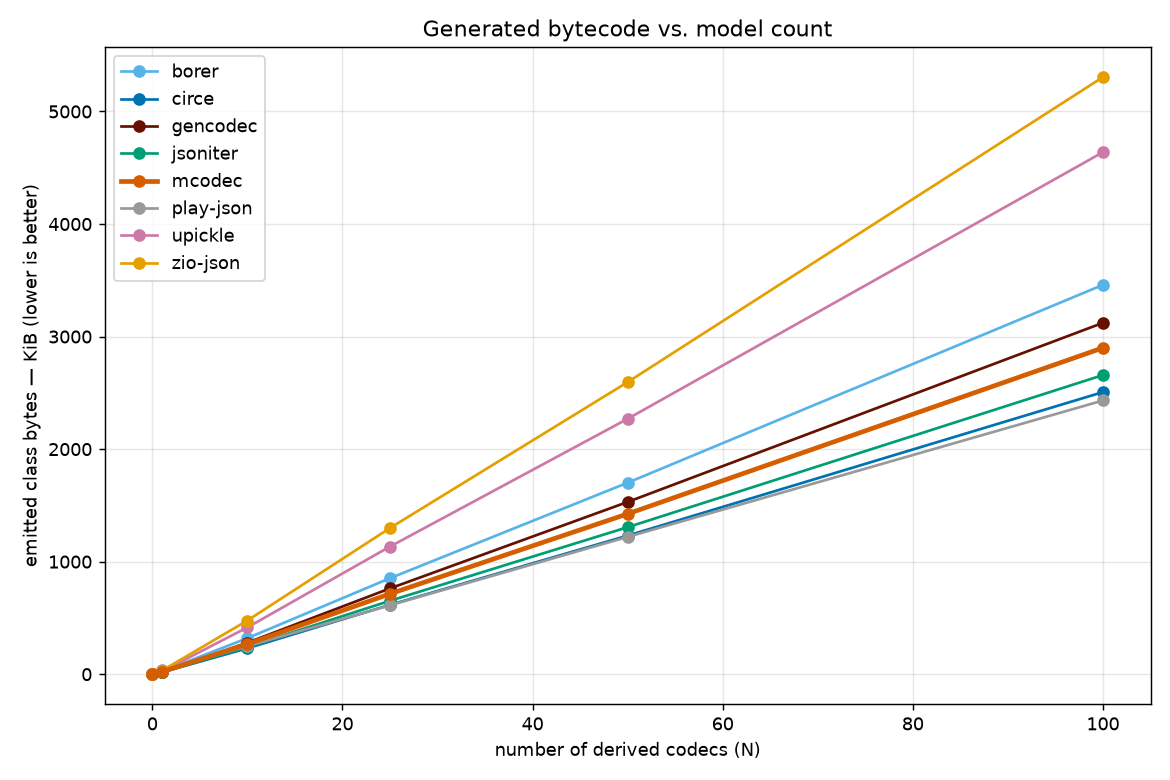
Under that constraint, the numbers still moved. Compiling 100 derived codecs cost 14 seconds and 9,105 KB of bytecode when I started; today it costs 9.6 seconds and 2,900 KB, the fourth-lightest bytecode footprint of the eight libraries, ahead of uPickle’s 10.0 seconds on compile time. How I got there is its own story, covered below. Worth repeating here: mcodec still isn’t the fastest-compiling library in the field, but every bit of this came without a single new macro, blackbox or whitebox.
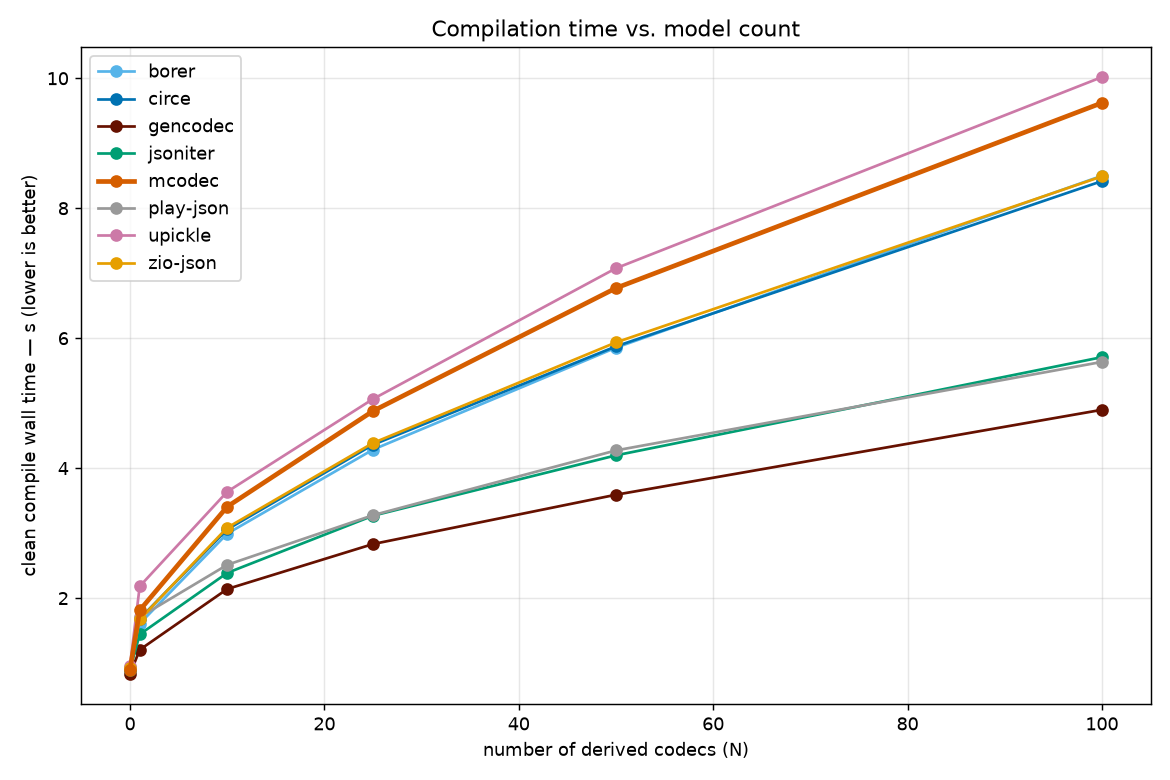
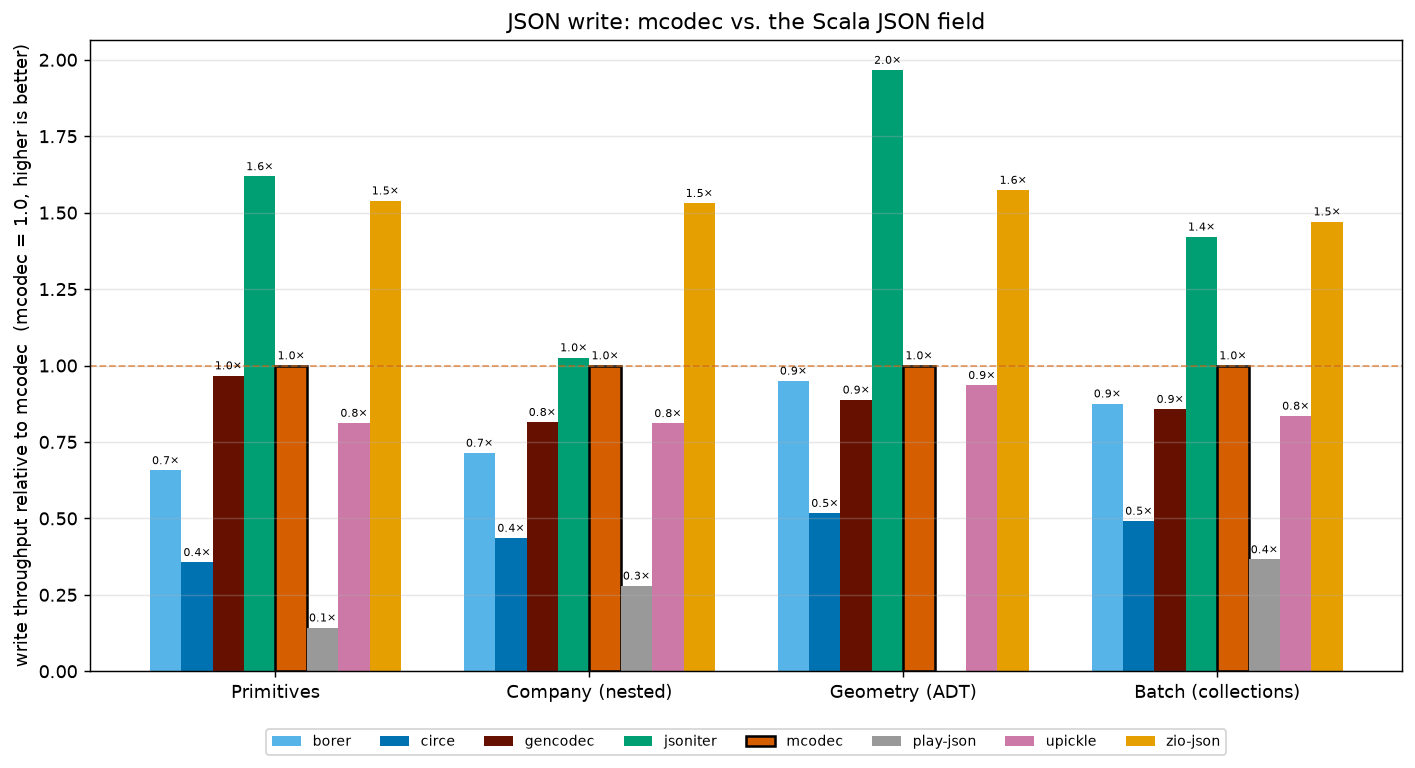
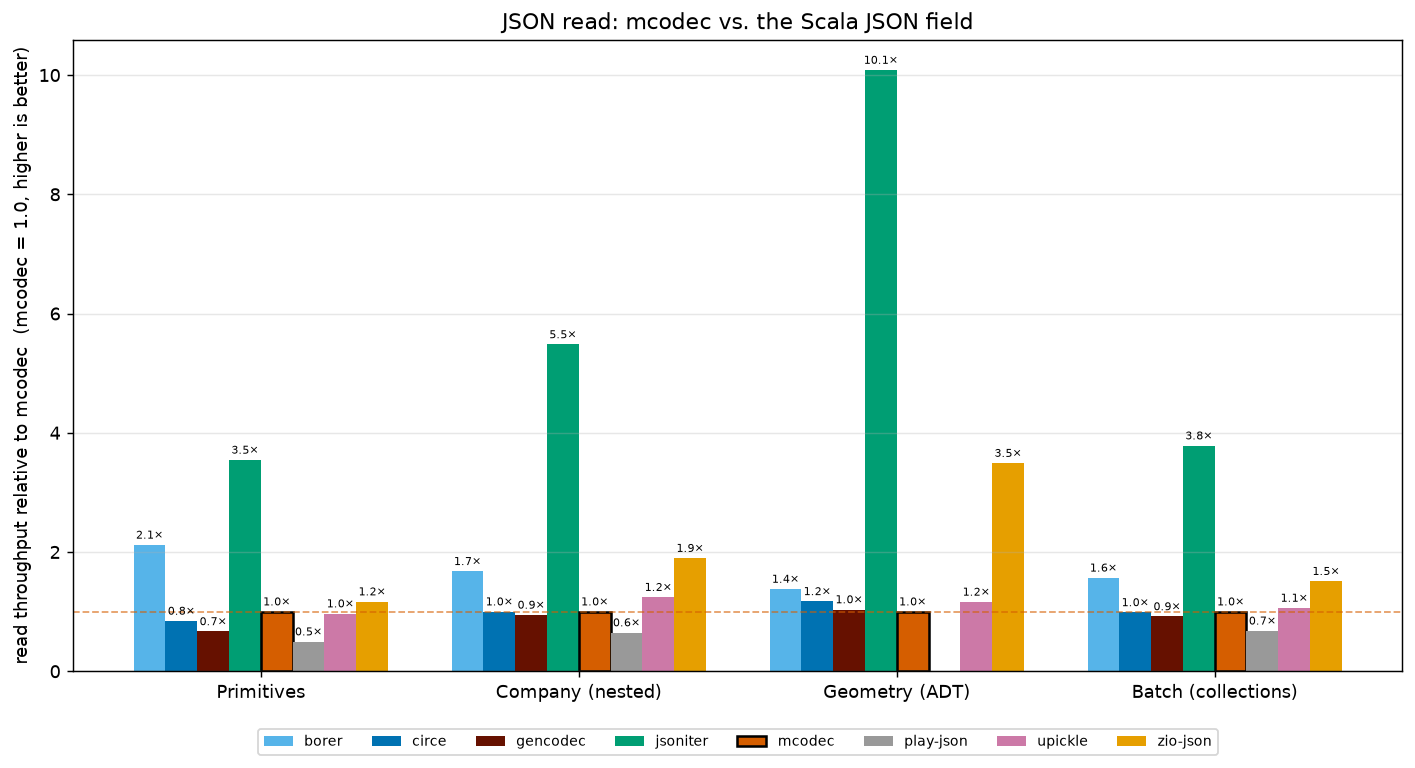
Runtime performance wasn’t the priority; it happened to work out like this: on writes, mcodec now beats every library in
the comparison except jsoniter-scala and zio-json. Read numbers look different, trailing zio-json, borer, and
jsoniter-scala, and slowest of the group on the self-recursive Geometry ADT.
None of that bytecode drop came from touching mcodec’s own derivation code. The single largest cut, 9,105 KB down to
4,986 KB, came from a made 0.6.0 change that had nothing to do with codecs: before it, mirrors compiled each
MadeFieldElem in the elems tuple to its own anonymous class per field, generated fresh at every derivation site;
0.6.0 collapsed that into shared concrete classes carrying real type parameters. The same change cut typer time by 23%
and genBCode time by 42%, the two phases that elaborate and emit those classes. That is the point of putting the
mirror behind a shared library instead of a macro per project.
One lever is still sitting untouched: the containsOnly proofs Made and commons thread through derivation exist
purely to satisfy the type checker and are never read at runtime. Scala’s experimental
erased definitions would let the compiler
drop parameters like that from the bytecode outright, instead of merely compiling them down to something nobody reads.
If they stabilize, the number above has room to fall further.
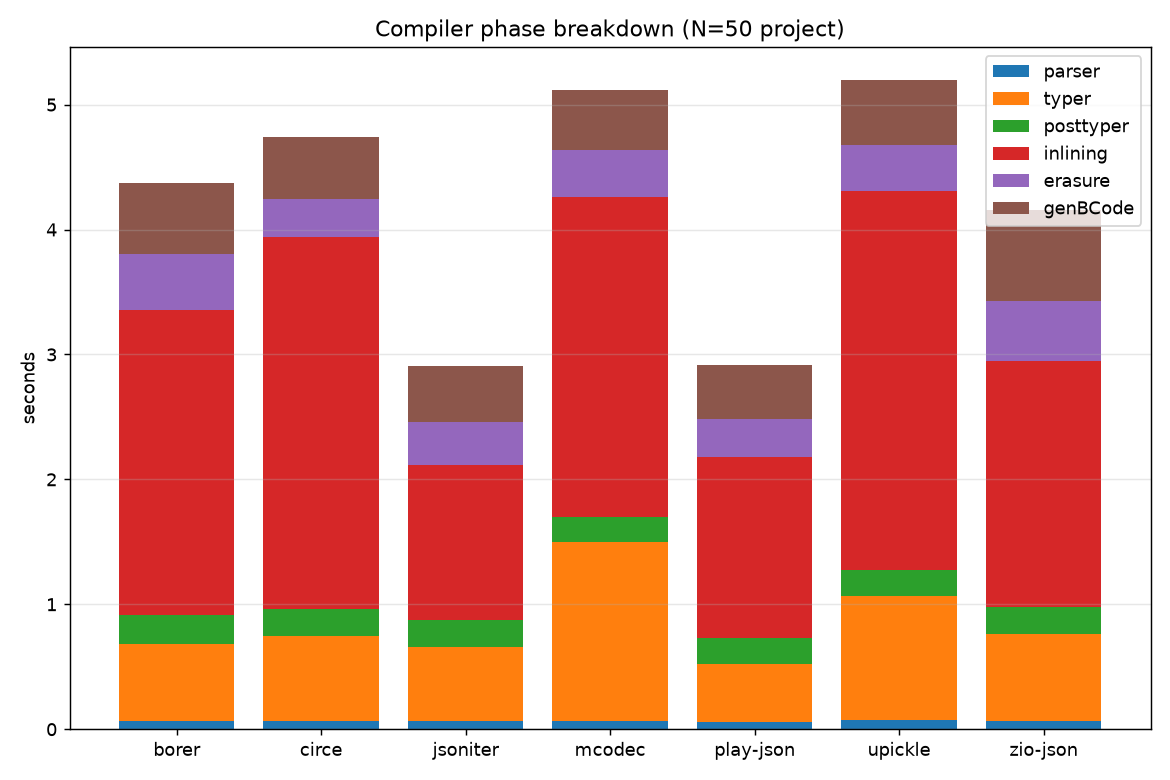
Compile time is mcodec’s weakest number against the field, and the reason traces to one mechanism: Made.derived is a
transparent inline given, so Scala expands the call during inlining and then re-elaborates the expanded code through
typer a second time. A macro-based library skips that second pass entirely: it splices in a tree the macro already
built fully typed, so the compiler never has to check it again. mcodec’s own typer cost is the highest in the
comparison: uPickle runs 30% below it, and the rest of the field sits 51-68% below it, play-json trailing furthest.
inlining is a little more competitive, 14-15% below the two highest, uPickle and circe. Being macro-based buys no
guarantee either: uPickle posts the worst inlining number and the second-worst typer in the whole group.
Trying It
M&DE is published to Maven Central as com.halotukozak::made, you can add it to your project with:
//> using scala 3.9.0It borrows from AVSystem commons and ops-mirror.
mcodec is the fullest example of what building on it looks like in practice.
If you build something on it, I would like to hear about it!